
Introduction: The Fine Line Between “Military Style” and “Mission Ready”
In the high-stakes world of defense procurement, a boot is never just a boot. It is a critical piece of survival equipment. For a soldier deployed in the arid mountains of the Middle East, a peacekeeper in the jungles of Africa, or a police officer patrolling the urban streets of Europe, footwear failure is not an option. A separated sole, a crumbled midsole, or a broken zipper isn’t a warranty claim—it is a mission liability.
Global benchmark brands like Garmont Tactical, Belleville, and Altama have set the gold standard for what operators expect: durability, stability, and comfort under fire. However, for government tender winners and private security firms (PMCs), the challenge is not just finding these boots, but finding a tactical boots manufacturer capable of producing them at scale, within budget, and strictly adhering to Military Specifications (Mil-Spec).
We are that strategic manufacturing partner.
As a specialized OEM/ODM factory, we bridge the gap between “commercial tactical fashion” and true combat-ready footwear. This guide is written for procurement professionals who need to understand the technical realities of manufacturing boots that meet global standards like AR 670-1, NATO specifications, and EN ISO 20347.
Decoding the Standards (AR 670-1, NATO, ISO)
To manufacture for the military, you must speak their language. “Mil-Spec” is not a marketing buzzword; it is a rigid set of technical parameters that define the difference between a toy and a tool.
1. AR 670-1 Compliance (The US Army Standard)
For clients supplying the US market or US-allied forces, the AR 670-1 regulation (specifically DA PAM 670-1) is the bible. If a boot does not meet these specs, it cannot be worn with the OCP (Operational Camouflage Pattern) uniform. As a manufacturer, we adhere to these strict constraints:
Height: The boot must be 8 to 10 inches in height.
Color: Coyote Brown 498 (specific Pantone).
Material: Flesh-side out cattlehide leather (Rough-out). No mesh is allowed on the main body to prevent sand ingress.
Sole Construction: The outsole must be rubber or PU and cannot extend over the toe (no “bumper”). The sole height cannot exceed 2 inches.
Why We Excel: We have specific molds designed to meet these exact dimensions, ensuring your product is “Authorized for Wear.”
2. EN ISO 20347 & 20345 (The European Standard)
For tenders in Europe or Commonwealth nations, certification is key. We work with accredited labs like Intertek, SGS, and CTC to certify our boots under the following classifications:
O2 Rating: Occupational footwear with water penetration resistance and energy absorption in the heel. Ideal for patrol duties.
S3 Rating: Safety footwear with an anti-penetration midsole (Kevlar or Steel) and a protective toe cap (Composite or Steel).
SRC Rating: The highest level of slip resistance, tested on ceramic tiles with SLS and steel floors with glycerol. This is crucial for Police Boots used in urban environments where wet tiles and oil spills are common.
3. NATO CAGE Code & Supply Chain
While we operate as an OEM factory, we support clients who hold NATO CAGE Codes (Commercial and Government Entity Code). We understand the documentation required for defense logistics, including detailed Bill of Materials (BOM), Certificate of Conformance (CoC), and Berry Compliance alternatives.
Part 2: The “Big Three” Tactical Scenarios
A “one-size-fits-all” boot does not exist in modern warfare. Based on our manufacturing data and global trends from brands like Milforce and Garmont, we categorize our production into three core mission profiles.
Scenario A: The Desert Operator (Hot Weather Combat Boots)
Target Environment: Middle East, Africa, Arid Zones.
Benchmark Model: Garmont T8 Bifida / Belleville C390.
Our Manufacturing Spec:
Upper: 2.0mm – 2.2mm Rough-out Cattlehide Leather. We use rough-out because it doesn’t require polishing and hides scuffs from rocks.
Ventilation: We integrate medial drainage vents (screened to stop sand) to allow heat to escape.
Sole: A Vibram-style cup sole with aggressive multi-directional lugs for traction in loose sand.
Key Feature: No metal hardware. Metal eyelets can get dangerously hot in the desert sun; we use durable nylon loops or coated brass speed hooks.
Scenario B: The Jungle Specialist (Tropical Warfare)
Target Environment: Southeast Asia, South America, Swamp Terrain.
Benchmark Model: Classic US Jungle Boot / Altama Jungle.
Our Manufacturing Spec:
Upper: A hybrid of leather and 1000D Cordura® Nylon. The nylon panels allow the boot to dry rapidly after submersion.
Drainage: Essential. We install brass drainage ports near the arch that push water out with every step.
Sole: The legendary “Panama Sole” design. These large, widely spaced lugs are designed to shed mud. A tight tread pattern would clog instantly in the jungle, turning the boot into a slick ski.
Protection: We add a steel or Kevlar plate in the sole to protect against Punji stakes (traps).
Scenario C: The Urban Enforcer (Police & SWAT Boots)
Target Environment: Cities, Tarmac, Indoor Operations.
Benchmark Model: Bates GX-8 / 5.11 A.T.A.C.
Our Manufacturing Spec:
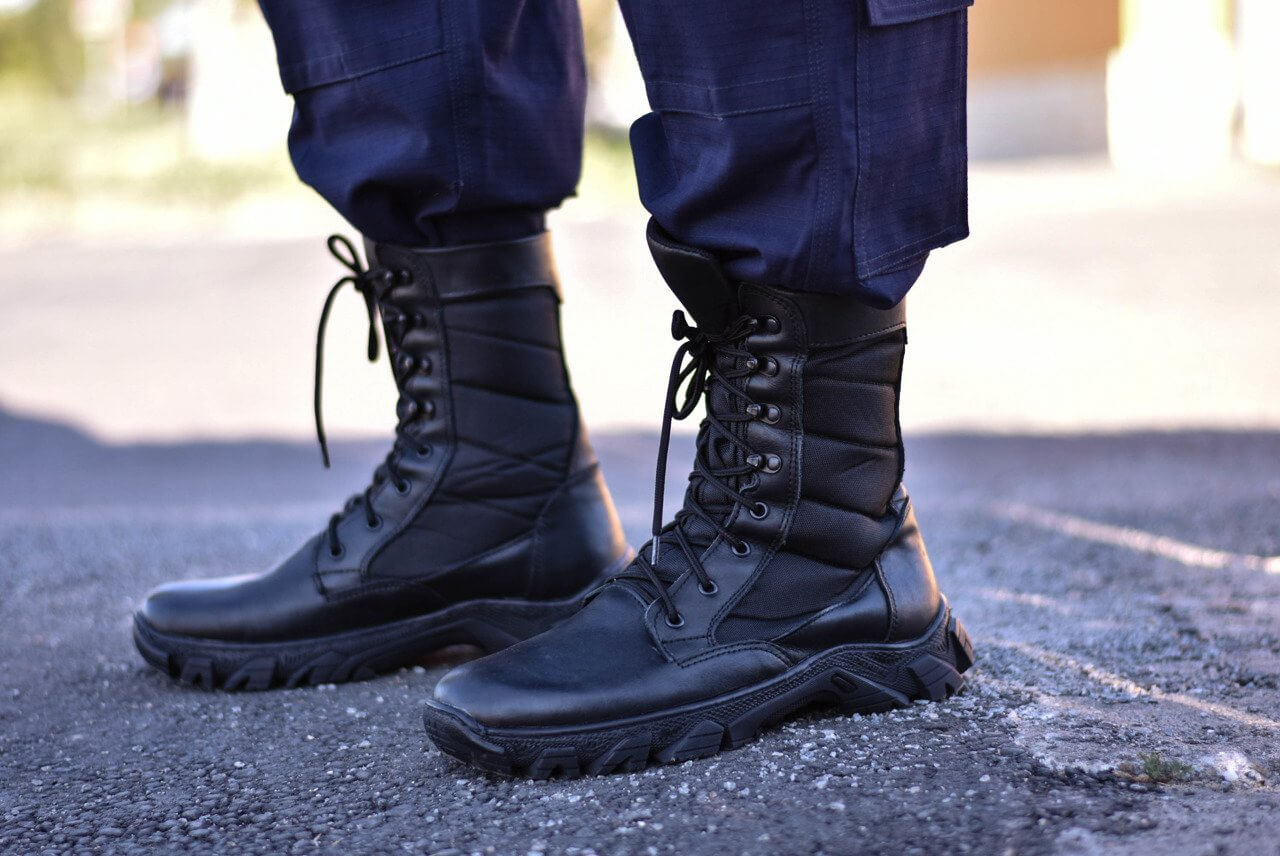
Upper: Smooth Top-Grain Leather (polishable) combined with ballistic nylon. Police officers need a professional appearance.
Entry: YKK® Side-Zippers. Rapid response teams need to get their boots on in seconds. We use a Velcro tab to secure the zipper pull.
Sole: An Oil-Resistant & Slip-Resistant rubber outsole. Quiet, squeak-free, and grippy on wet concrete.
Weight: Engineered to be lightweight (athletic fit) for foot chases.
Material Science – The Anatomy of Survival
You cannot build a tank out of tin. Similarly, you cannot build a Mil-Spec boot out of cheap synthetic leather. Here is the breakdown of the premium materials we source for our OEM military boots.
1. The Leather: Full Grain vs. Split
For government tenders, we strictly use Full Grain Cattlehide or high-grade Nubuck.
Why? Cheap “Split Leather” (coated with PU) peels under heat. Full Grain leather breathes, molds to the soldier’s foot, and offers natural water resistance.
2. The Textile: CORDURA® Nylon
We don’t use generic polyester. We use CORDURA® (1000D or 1680D).
Why? It has exceptional resistance to tears, scuffs, and abrasions. It is the same material used in military rucksacks and plate carriers.
3. The Hardware: YKK® and Non-Magnetic
For side-zip boots, we exclusively use YKK® Vislon or Coil zippers. A jammed zipper in an emergency is unacceptable. For EOD (Explosive Ordnance Disposal) teams, we use non-magnetic hardware to avoid triggering devices.
4. The Midsole: Kevlar vs. Steel
In modern safety tactical boots, we are shifting from Steel Plates to Kevlar (Aramid) Anti-Penetration Midsoles.
Why? Kevlar is 30% lighter than steel, flexible, and doesn’t set off metal detectors, making it ideal for airport security personnel.
Manufacturing Tech – DMS vs. Cementing
How we attach the sole is the most critical decision in the manufacturing process. We offer two primary construction methods:
Method 1: Direct Molded Sole (DMS) – The Combat Standard
This is the preferred method for large-scale army contracts.
The Process: The upper is placed in a mold, and molten rubber is injected and vulcanized directly onto the leather.
The Advantage: The sole is physically fused to the upper. It cannot separate, even in high heat or extreme humidity.
Best For: Desert boots, Jungle boots, Mass deployment.
Method 2: Cement Construction – The Tactical Standard
This is common for SWAT and lightweight patrol boots.
The Process: The outsole is pre-molded and then glued to the upper using high-performance adhesives and heat pressing. We often reinforce this with Toe Stitching.
The Advantage: Lighter weight, more flexible, and allows for complex EVA/Rubber midsole combinations (like a running shoe).
Best For: Police boots, Urban tactical boots.
Winning Government Tenders (The “Golden Sample”)
We are more than a factory; we are a Tender Support Partner. We understand that winning a government contract requires more than a low price.
1. The “Golden Sample” Process
In any tender, the “Golden Sample” is the master reference.
We produce a prototype that meets every line item of the tender spec.
Once the committee approves this sample, we seal it.
Our QC team ensures that every pair in the 50,000-pair mass production run matches the Golden Sample exactly.
2. Third-Party Lab Testing
We don’t ask you to take our word for it. We send batch samples to SGS, Intertek, or CTC to test:
Bond Strength: >4.0 kg/cm .
Abrasion Resistance: NBS Index > 100%.
Flex Resistance: 50,000 cycles without cracking.
Slip Resistance: SRC Standard.
3. Berry Compliance Solutions
Note for US Clients: The “Berry Amendment” requires 100% US manufacturing for DoD funds.
Our Solution: We offer “Berry Compliant Style” boots. These are manufactured in our offshore facilities to the exact same specs and quality as the US-made versions but at a fraction of the cost. This is the perfect solution for Private Military Contractors (PMCs), foreign military sales (FMS), and law enforcement agencies that are not bound by the Berry Amendment but want Mil-Spec quality.
Frequently Asked Questions for Procurement Officers
Here are the top 10 questions we receive from defense contractors and government buyers:
1. Q: Do you have a NATO CAGE Code?
A: We operate as an OEM/ODM manufacturing partner. While we do not hold a CAGE code ourselves, we manufacture for many clients who do. We provide all necessary documentation (BOM, CoC) to support your contract compliance.
2. Q: What is the Minimum Order Quantity (MOQ) for custom Mil-Spec boots?
A: For fully custom designs (e.g., specific camo pattern or custom mold), the MOQ is 1,000 pairs. However, if you use our “Open Molds” (existing tooling similar to Garmont or Belleville styles), we can support orders starting at 500 pairs.
3. Q: Can you produce “Berry Compliant” boots?
A: We produce “Berry Compliant Style” boots. Since our facilities are outside the USA, they cannot be certified as Berry Compliant (which requires 100% US origin). Our boots are ideal for non-US military contracts, PMCs, and commercial tactical sales where US origin is not a legal requirement.
4. Q: How do you handle quality control for large orders?
A: We follow AQL 2.5 / 4.0 standards. For every container, we perform a random inspection of 10-20% of the goods. We also welcome your third-party inspectors (like SGS) to our factory before shipment.
5. Q: Can you brand the boots with our logo?
A: Yes. We are an OEM/ODM specialist. We can emboss your logo on the leather, add it to the tongue label, and even mold it into the outsole (requires new mold tooling).
6. Q: What is the lead time for a tender order of 10,000 pairs?
A: Once materials are prepared, our production capacity is approximately 2,000 pairs per day per line. For an order of 10,000 pairs, including material sourcing, the typical lead time is 45-60 days.
7. Q: Do you provide samples for tender submission?
A: Yes. We can create a “Golden Sample” based on your tender documents. There is a sample fee, which is refundable upon placement of the bulk order.
8. Q: What testing reports can you provide?
A: We can provide internal test reports for every batch. For official certification (EN ISO 20347), we can send samples to Intertek or CTC on your behalf (testing fees apply).
9. Q: Can you handle DDP (Delivered Duty Paid) shipping?
A: Yes. We work with specialized freight forwarders who handle military logistics. We can ship DDP to your warehouse or directly to a government depot in many countries.
10. Q: Do you use real Cordura and YKK?
A: Yes. We have authorized supply agreements with Cordura and YKK. We can provide the official hangtags and transaction certificates to prove authenticity.
Conclusion & Practical Advice: Your Strategic Supply Partner
Sourcing tactical and police boots is a balance of performance, price, and trust. You need a partner who understands that a boot is a tool, not a toy.
At Wenzhou Jinhua Shoes, we combine the material science of top brands like Garmont with the manufacturing flexibility of Milforce. We are ready to help you win your next tender and deliver footwear that brings every soldier home safely.
Practical Checklist for Buyers (Save This)
Before you finalize your supplier, check these three critical points:
Check the Weight: A true tactical boot should balance protection and weight. Aim for 550g – 650g per boot (size US 9). Anything heavier causes fatigue; anything lighter might lack durability.
Inspect the Stitching: Look for double or triple stitching in high-stress areas (heel and toe). Single stitching is a failure point in combat.
Demand the TDS: Always ask the factory for the Technical Data Sheet of the outsole rubber. If they can’t tell you the abrasion index (NBS) or hardness (Shore A), they aren’t a Mil-Spec factory.
Ready to discuss your specifications?
Contact Our Team Today – Send us your tender requirements, and let our engineering team build your Golden Sample.

 EN
EN  DE
DE  FR
FR  ES
ES  IT
IT  SV
SV  NB
NB  NL
NL  PL
PL  PT
PT  CS
CS  FA
FA  AR
AR  TR
TR  RU
RU  EL
EL  JA
JA  ID
ID  KO
KO