
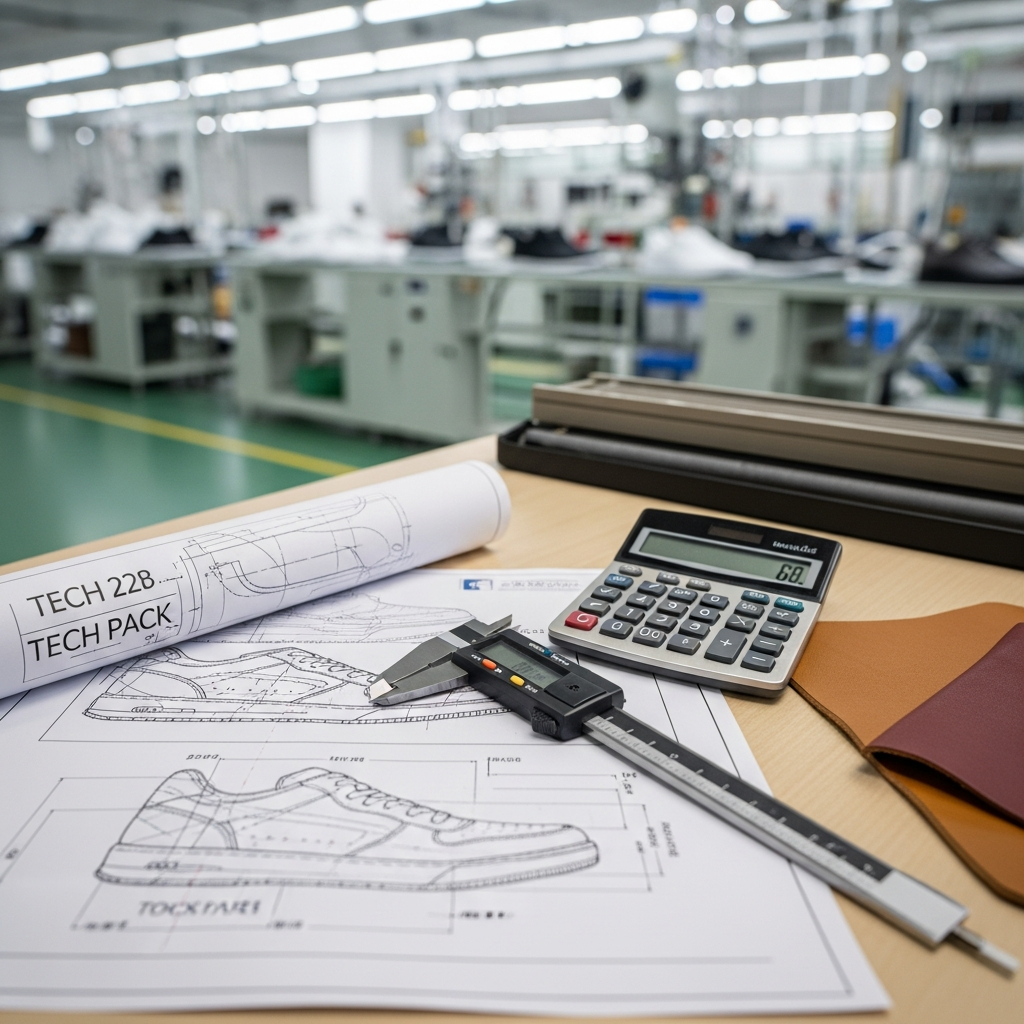
It happens almost every day in my office at Jinhua Shoes. A brand founder or a boutique wholesaler sends us a beautiful tech pack. They are excited to launch their first collection and ask for three quotes: one for a 300-pair “trial run,” one for our standard 500-pair MOQ, and one for an 800-pair bulk order.
When the quote hits their inbox, they are often shocked by the price gap. The unit price for 300 pairs might be $22.00, the 500-pair price drops to $17.50, and the 800-pair price hits a highly competitive $15.00. The immediate reaction is usually: “Is the factory just trying to squeeze more profit out of me because I’m small?”
Let’s be honest. From the outside, it looks like a penalty. But as a veteran consultant at a Wenzhou factory, I can tell you that the reality is much more technical. In the world of professional footwear manufacturing, the “Small Order Surcharge” isn’t a profit grab—it is a reflection of factory physics. When you order 300 pairs, the factory often makes less profit than on an 800-pair order, even with the higher price.
Today, I want to pull back the curtain on how a shoe manufacturer actually calculates your quote. We will look at the hidden costs of setup, the material market’s “small order” penalties, and how our Integrated Industry & Trade model at Jinhua Shoes helps bridge this gap, and why 800 pairs is often the “sweet spot” for brand margins.
The Fixed Cost Trap: The “Invisible” Work
Whether we are making 300 pairs or 30,000 pairs of a new sneaker, the “pre-production” workload is exactly the same. Before a single shoe is lasted on the assembly line, our team has to perform dozens of tasks that the customer never sees.
First, there is the Paper Pattern and CAD development. Our technicians must take your 2D sketch and turn it into a 3D reality, grading the patterns for every size in your run (e.g., US 7 through 12). This takes hours of skilled engineering. Second, we have to manufacture the Clicking Dies (the sharp metal “cookie cutters” used to cut the leather). A full set of dies for one style can cost between $400 and $800.
If you order 800 pairs, that $600 die cost is spread out at $0.75 per pair. If you only order 300 pairs, that same cost jumps to $2.00 per pair. This is the “Fixed Cost Trap.” The machines don’t care how many shoes you are making; they still need the same patterns, the same dies, and the same technical oversight to ensure the shoe fits correctly.
Material Sourcing Realities: Why 800 Pairs is the “Magic Number”
Wenzhou is the “Shoe Capital of China” because of its massive material markets. However, these markets operate on Wholesale logic.
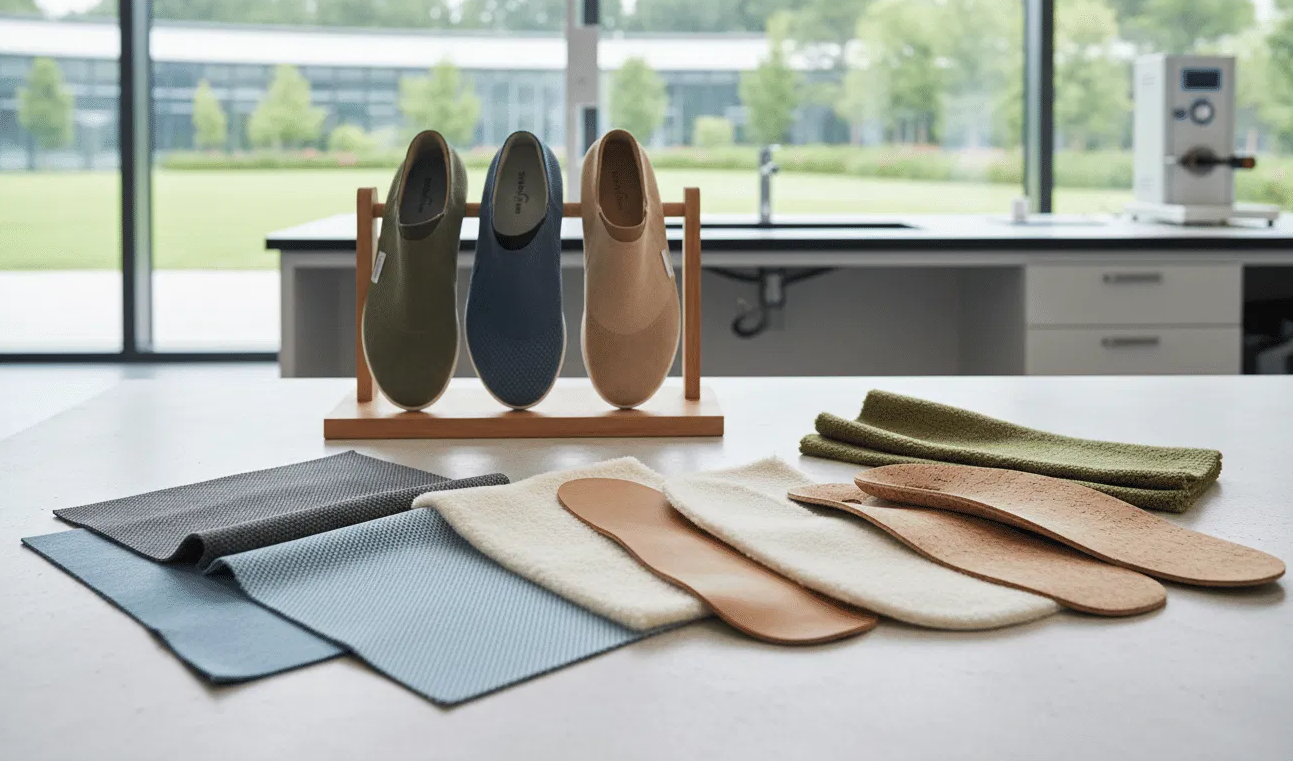
When we source a premium cowhide or a GRS-certified recycled mesh, the material suppliers have their own MOQs. Usually, they won’t even turn on their dyeing vats for less than 500 or 1,000 meters of fabric.
At 300 pairs: We often have to pay a “Small Batch Surcharge” to the supplier, which can be 30% to 50% higher than the bulk price.
At 500 pairs: we hit the supplier’s minimum, and the surcharge disappears.
At 800 pairs: We often reach a volume where we can negotiate a bulk discount on the leather or outsoles.
This is why the price drop from 300 to 800 is so dramatic. At 800 pairs, you aren’t just “buying shoes”; you are buying materials at the same price level as the big brands.
Furthermore, small orders often mean we cannot use “custom-dyed” materials. We are forced to use “stock colors.” If you insist on a very specific Pantone shade for a small run, the cost of the material alone can double. At Jinhua Shoes, we use our sourcing power to negotiate these surcharges down, but we cannot eliminate them entirely.
The Assembly Line “Rhythm” Problem
A modern footwear assembly line relies on “rhythm.” When a new style starts on the line, the first 100 pairs are always the slowest. The workers are learning where to place the stitches and how much tension to apply to the lasting machine.
If your order ends at 300 pairs, the factory has spent the entire time in the “learning phase,” which is the most expensive and least efficient part of production. However, for an 800-pair order, the factory gets 500 pairs of “high-efficiency” production. This efficiency gain is passed directly to you in the form of a lower unit price.
For an 800-pair order, the factory gets 500 pairs of “high-efficiency” production to offset the slow start. This is why many factories in Jinjiang or Dongguan won’t even look at an order under 1,000 pairs—the loss of efficiency simply isn’t worth the disruption to their schedule.
The Hidden Math of Mold Fees: How Volume Slashes Your Unit Price
If your design requires a custom outsole, you are entering the most expensive part of shoemaking: Mold Fees. A full set of private molds for a sneaker (covering a standard size run) can cost anywhere from $2,500 to $5,000.
Let’s look at the math:
300 Pairs:
3,000moldfee/300=10.00 per pair in amortization.500 Pairs:
3,000moldfee/500=6.00 per pair in amortization.800 Pairs:
3,000moldfee/800=3.75 per pair in amortization.
By moving from 300 to 800 pairs, you’ve already saved $6.25 per pair just on the molds alone! This is why we often advise startup brands to use our “Open Mold“ library at Jinhua Shoes to keep costs down for their first 300-pair run.
The Jinhua Shoes Advantage: Integrated Industry & Trade
This is where our business model becomes your secret weapon. Most “factories” are just production houses; they don’t have the staff to handle the complex sourcing and communication required for small, high-detail orders. Most “trading companies” don’t own the machines, so they have to add a massive markup to cover their risk.
Jinhua Shoes is an Integrated Industry & Trade company.
Factory Power: We own the production lines in Wenzhou. You get the direct price without the middleman’s 20% markup.
Trading Service: We have a professional sourcing and R&D office. We don’t just tell you “the price is high.” We work with our material suppliers—with whom we have 20-year relationships—to find “leftover” premium materials or stock lots that fit your 300-pair budget.
We treat a 300-pair order as an investment in a future partnership. We provide the high-level communication of a boutique agency with the raw pricing power of a Wenzhou manufacturer.
Value Engineering: 3 Ways to Lower Your Price on Small MOQs
If you must stay at a 300-pair volume, here is how you can lower your unit price:
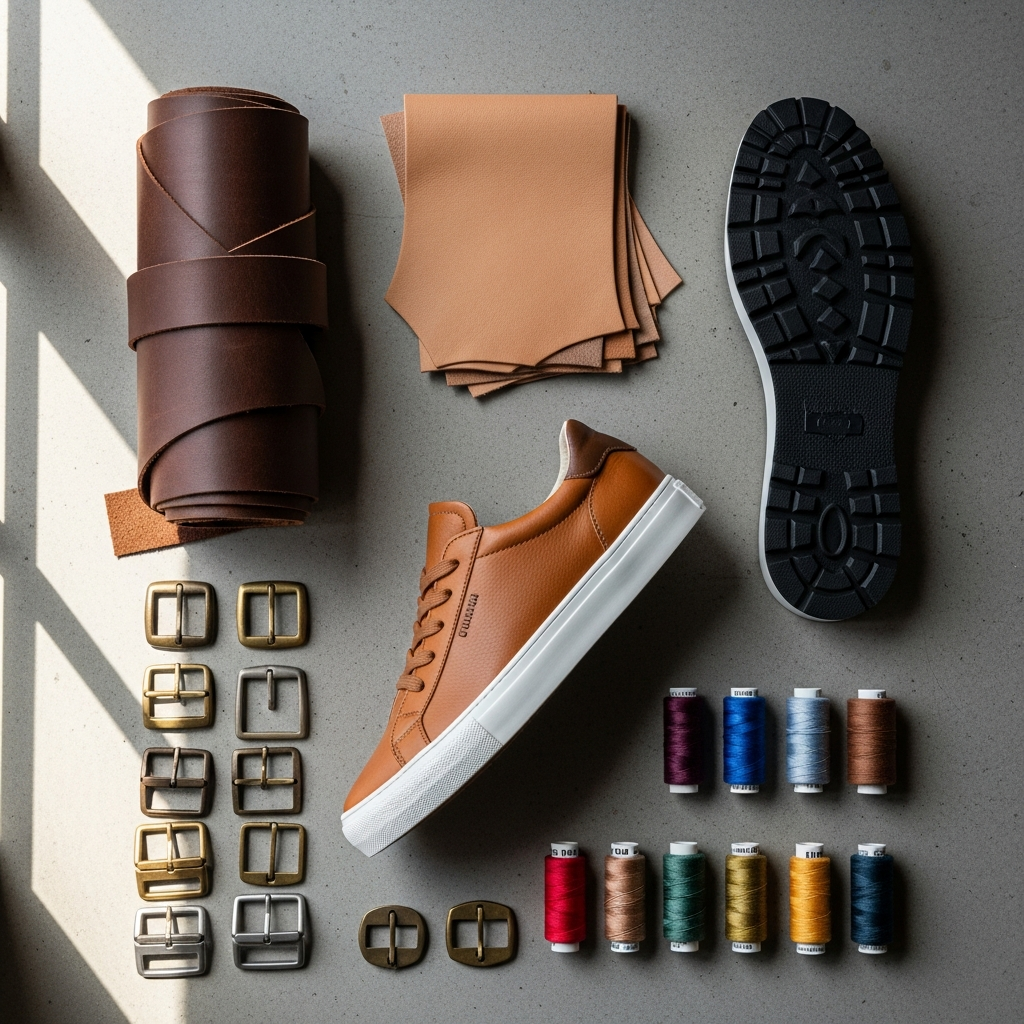
Material Consolidation: Use the same leather or fabric across three different styles. If we can buy 500 meters of one fabric to make 900 shoes (3 styles x 300 pairs), the material surcharge disappears.
Standardize Your Hardware: Don’t design a custom-engraved buckle for a small run. Use a high-quality standard buckle and focus your branding on the insole or a woven label, which have much lower MOQs.
The “Open Mold” Strategy: As mentioned, using a factory’s existing outsole mold is the single fastest way to save $5.00 to $10.00 per pair on a small order.
Frequently Asked Questions (FAQ)
1. Is 500 pairs the absolute minimum for Jinhua Shoes?
Our standard MOQ for fully custom OEM designs is 500 pairs per style per color. However, we can support trial orders of 300 pairs, but these incur a “Small Batch Surcharge” to cover material and setup costs.
2. Why does the shipping cost per pair also go down with 800 pairs?
Logistics companies charge by volume (CBM). Shipping 800 pairs via sea freight is significantly cheaper per unit than shipping 300 pairs via LCL (Less than Container Load).
3. Can I mix sizes to reach the 500-pair MOQ?
Yes! A standard MOQ of 500 pairs includes a full Size Run (e.g., a 1-2-3-3-2-1 ratio). You do not need to order 500 pairs of a single size.
4. If I re-order the same style later, will the price be lower?
Yes. For repeat orders, you don’t have to pay for new paper patterns or clicking dies. Your second-run price is usually lower.
5. Does the 300-pair price include custom packaging?
Custom shoeboxes usually have their own MOQ of 1,000 units. For a 300-pair order, we recommend using a high-quality “blank” box with a custom-branded sticker to keep costs down.
6. Why is the price for “Vegan Leather” sometimes higher than real leather for small orders?
High-end bio-based vegan leathers are often made to order. Their MOQs are very strict, making small-batch sourcing very expensive compared to stock cow leather.
7. Can I provide my own materials to lower the price?
Yes, we accept “CMT” (Cut, Make, Trim) orders. However, you must factor in the cost of shipping those materials to our Wenzhou factory.
8. How long does it take to get a quote for 300, 500, or 800 pairs?
At Jinhua Shoes, we provide a preliminary cost analysis within 12 hours. We give you all three price points so you can make an informed decision.
9. What is a “Development Fee”?
This is a one-time fee for making your initial samples. At Jinhua, we often refund this fee once you place a bulk order that meets our 500-pair standard.
10. Is it better to start with 300 pairs or hit the 800-pair tier?
If you have a design you truly believe in, pushing that order to 800 pairs is the fastest way to instantly boost your profit margin by 20% or more.
Conclusion: Quality is a Choice, But Profit is a Strategy
In the footwear business, price is always a function of preparation. The reason 300 pairs cost more than 500 isn’t a mystery—it is the literal cost of the patterns, the dies, the material surcharges, and the assembly line’s learning curve.
Here is my final advice for your next collection: Stop looking at the unit price in a vacuum. Instead, look at your Total Investment. Sometimes, paying $5.00 more per pair for a 300-pair run is the smartest way to protect your cash flow while testing a new market. But if you want the best possible retail margin, aiming for the 800-pair tier is where the real profit is made.
At Jinhua Shoes, we don’t just want to be the factory that takes your order; we want to be the technical consultant that helps you scale. We are here to help you “Value Engineer” your tech pack, finding that elusive sweet spot where your design vision meets your budget reality.
Ready to Optimize Your Production Costs?
If you feel your current production costs are too high, or if you’ve received a quote from another supplier that just doesn’t make sense, let us take a look. We offer a Free Cost Engineering Audit for serious brand owners.
Send us your Tech Pack today, and our Wenzhou team will provide:
A Detailed Cost Breakdown: See exactly where every cent of your budget is going.
Value Engineering Suggestions: Practical ways to lower unit prices without sacrificing the “look” or quality.
Construction Comparison: A transparent analysis of which manufacturing method fits your current volume best.
Stop overpaying for guesswork and start building a scalable supply chain. Contact our expert team today for a transparent, factory-direct quote. Let’s build your next bestseller together.
📧 Email your Tech Pack to: sales@jinhuashoes.com
🌐 Explore our capabilities: www.jinhuashoes.com
 EN
EN  DE
DE  FR
FR  ES
ES  IT
IT  SV
SV  NB
NB  NL
NL  PL
PL  PT
PT  CS
CS  FA
FA  AR
AR  TR
TR  RU
RU  EL
EL  JA
JA  ID
ID  KO
KO